
At The Department of Human Dynamics, we build to operationalize belonging: Agents with strong, situated priors, visible bias toward local norms, and stances that update with evidence.
Models must Humans learn early to shift register across settings, school voice, home voice, , friends voice, that competence is real cognitive work and cultural intelligence (,).
ChatGPT can explain every social norm yet them constantly, because it holds no social state and lacks live feedback loops.

Belonging as local norms performance
Belonging isn't recognition; it's local norms performance. We all do it, we try the local style, get corrected, adapt, and are accepted (,).
For humans, belonging is a learned social literacy governed by peer feedback and reward, where style, timing, references, ritual, and taste operate as  LIVENovaVortex84.9k followers
 CodeCure@codecure · 13hJust got my hands on Grok and… wow. The speed, the reasoning, the way it handles messy real-world prompts — genuinely impressive.Didn’t expect to be this into a new model, but here we are. 5.35.8 37.0k 229.0k
 999.0k 5.0k (). For machines, society is computable as a scene-local state vector with corresponding coordinates updated at each exchange by uptake (acknowledgment) and repair (correction), so actions align with the live norm.
These states are organized by shared symbols, boundaries, and enforcement; meaning each social moment can be apprehended as a microstate (). Much of this literacy is indexical, everyone hears the words; not everyone receives the message (,,,).

Words Do Things
They promise, they invite, they refuse, and, said the right way at the right moment, they change the social world ().
We model such performative utterances as state-vector updates. As such acts repeat across situations, they harden into habits, and those habits read as identity. Once identities are stabilised, expected moves that feel natural to everyone involved will emerge (,).
These tiny cues enable 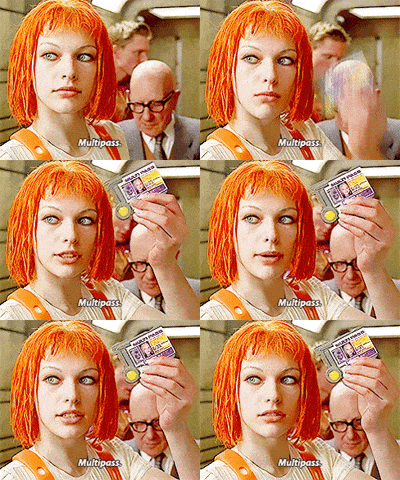
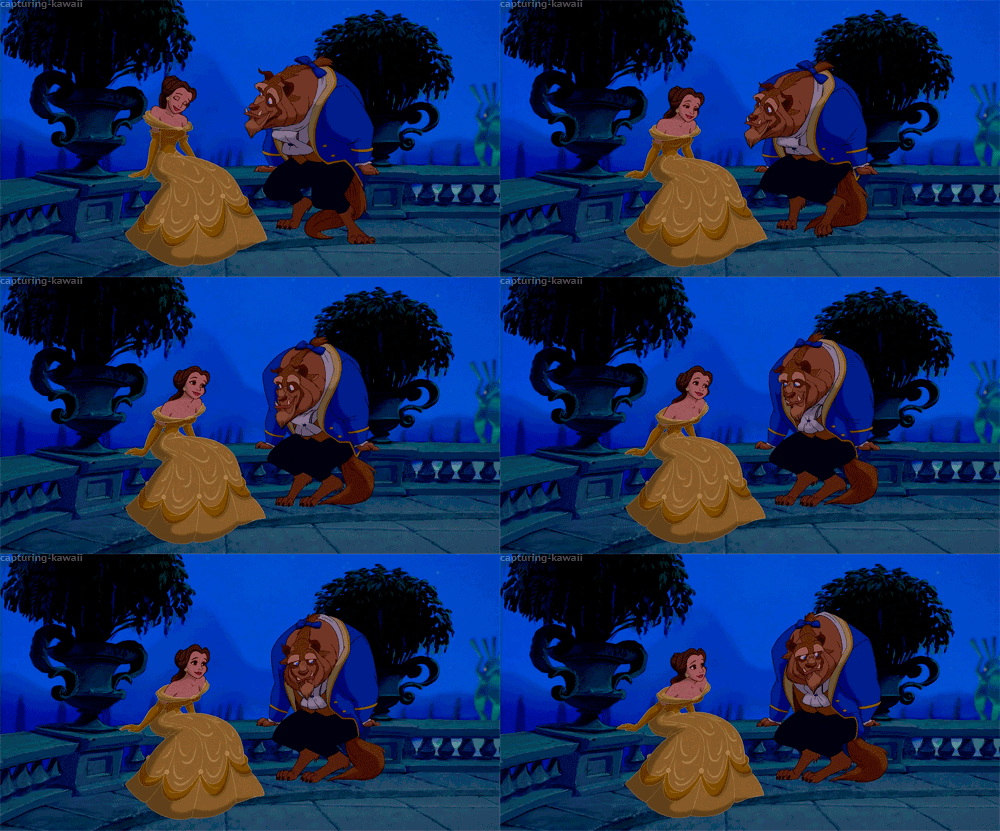


 to draw boundaries and grant belonging, then reward the aligned and resist the misfit (,,).

The Internet Status Layer
Internet Social Score lvl
The Internet has instrumentalised this; status and ritual fit now drive adoption as much as information density (). Platforms externalize status as machine-readable tokens, follows, badges, and reputation scores acting as portable social capital (,).
With tokens in the loop, speech becomes strategy: speakers choose phrasing, timing, and ritual to signal quality and affiliation to audiences and ranking systems ().
Status is now a service layer on top of distribution, where belonging is increasingly priced in signals, not just information (,,). As personas become interfaces, systems can learn which speech acts, formats, and rituals earn acceptance in a given scene
The Department
of Human Dynamics
Social World Models for machines that belong
Contact us

